
Short answer: A commercial kitchen hood fire suppression system must be serviced by a qualified technician at least every six months and after any discharge. Manufacturers also call for an inspection right after major hood and duct cleaning, and the owner or trained staff should check the system every month between visits.
How Often a Kitchen Hood Suppression System Must Be Inspected
The International Fire Code's commercial cooking section (§904.12 in the 2018 IFC, which the City of St. Louis enforces; §904.13 in the 2021 IFC) says the system must be "serviced at least every six months and after activation of the system." NFPA 96 sets the same six-month interval and adds that the person doing the work must be "properly trained, qualified, and certified" and acceptable to the authority having jurisdiction (AHJ). ANSUL's R-102 owner's guide also asks for inspection at a maximum of six-month intervals and "immediately after major hood and duct cleaning."
| When | What happens | Who does it |
|---|---|---|
| Monthly | Visual check: system armed, caps on, seals intact, tag in place | Owner or trained staff |
| Every six months | Full inspection, testing, and maintenance; new service tag and report | Qualified technician |
| After any discharge | Inspection, recharge, and a look at what set it off | Qualified technician |
| After major hood and duct cleaning | Confirm links and detection weren't disabled during cleaning | Qualified technician |
| Every 12 years | Hydrostatic test of wet-chemical agent cylinders | Qualified technician |
Metal-alloy fusible links are replaced at least every six months under NFPA 17A, NFPA 96, and manufacturer guidance; some code texts, including the IFC, set an annual minimum. Most providers follow the stricter six-month schedule. Hood and duct cleaning runs on its own schedule under NFPA 96 and is a separate service. Our NFPA 96 vs. NFPA 17A explainer covers which standard governs which part of the kitchen.
What Happens During a Semiannual Inspection
Visits differ by brand and provider, but a typical wet-chemical inspection follows the items on government semiannual report forms, such as California's form for pre-engineered wet-chemical systems:
- Check the hazard against the design. The technician confirms the hood, ducts, and cooking appliances haven't been replaced, modified, or moved, and that each appliance sits under the right nozzle. The report usually lists each appliance left to right with its nozzle type and flow points.
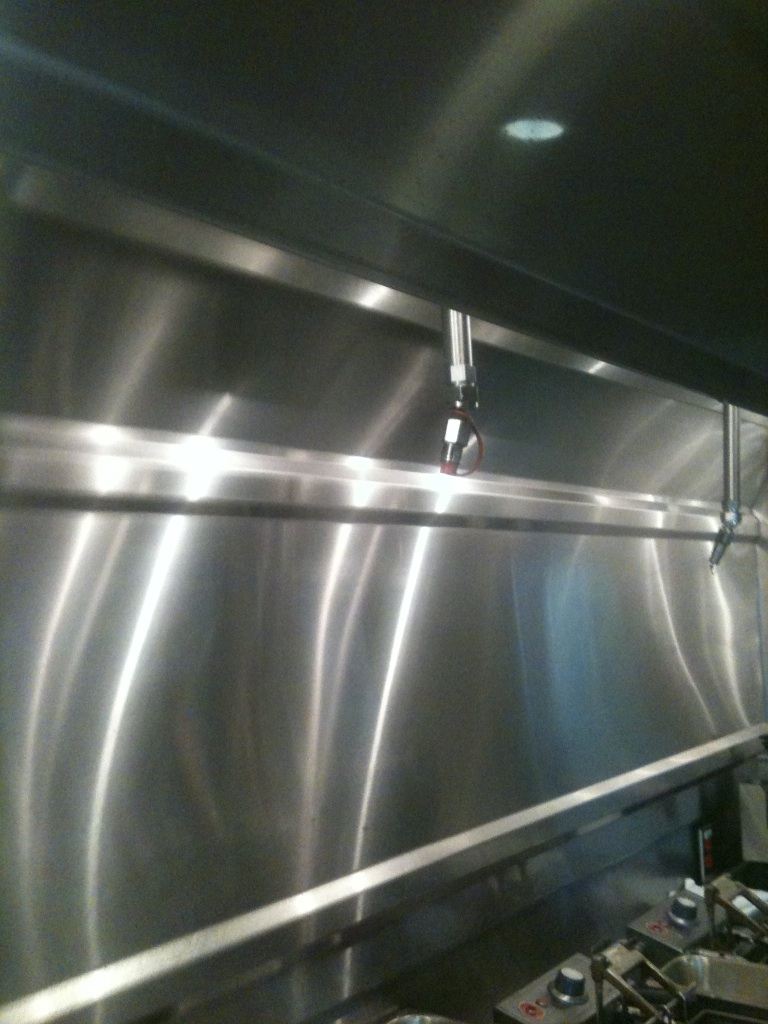
- Inspect the components. The remote pull station should be unobstructed, tamper seals intact, gauges in range, blow-off caps in place, and nozzles clean and properly aimed. Hoods, ducts, and filters should be in place.
- Test the system. NFPA 96 calls for testing all actuation and control components, including remote manual pull stations, mechanical and electrical devices, detectors, and actuators.
- Test the shutoffs. Actuation must automatically shut off fuel or electric power to the cooking equipment, and reset must be manual. The technician confirms the gas valve or electrical shunt operates and the manual reset relay works. Where the system is designed to interlock makeup air or tie into a building fire alarm, those connections are checked too.
- Do the maintenance items. These include checking cartridge weight and agent liquid level, confirming cylinders and hoses are within hydrostatic test dates, checking for corrosion, and making sure distribution piping is clear.
- Replace fusible links on the semiannual schedule and record their manufacture year and installation date.
- Tag and report. The technician updates the service tag and leaves a written report that lists anything that needs correction.
For a printable walk-through of everything a fire official may look at, including Class K extinguishers and hood cleaning labels, see the restaurant fire inspection checklist.
Monthly Checks the Owner Should Do
NFPA 17A expects a monthly inspection between professional visits, which trained staff can do. ANSUL's owner's guide adds a daily look at nozzle caps. A good monthly routine:
- The system is armed: no tampering at the releasing unit and visual seals are intact.
- The manual pull station is visible and nothing is stacked in front of it.
- The maintenance tag is in place and the last service date is within six months.
- Nozzle blow-off caps are on, intact, and not coated in grease.
- No loose pipes or obvious physical damage.
- Gauges, where present, read in the operable range.
- Appliances are back in their marked positions after cleaning.
- Filters are in place, and no corrosive or high-alkaline cleaner is used on fusible links or cables.
The Service Tag and Inspection Report
After the visit, the technician attaches a tag showing the service date and who did the work, and NFPA 96 calls for the fusible links' manufacture year and installation date to be recorded on it. A red tag generally means the system is inoperable or significantly impaired. In some states that triggers an order to stop cooking until repairs are made; in the St. Louis area, your fire department or fire protection district decides what an impairment means for your kitchen.
The IFC says a certificate of inspection is forwarded to the fire code official, so ask whether the provider files it or whether that falls to you. Keep the reports, invoices, and photos of each tag together. If the report lists deficiencies, the fire code deficiency repair page explains the correction process, and parts or recharges go through fire suppression repair and recharge.
Why Inspect Right After Hood Cleaning
Hood cleaners often wire fusible links shut so the system won't trip during cleaning. ANSUL warns that this "will prevent the system from operating automatically." If the links aren't restored, the kitchen goes back to cooking with a system that can't detect a fire. Scheduling the suppression inspection right after a major cleaning closes that gap.
Who May Perform the Inspection: Missouri vs. Illinois
The standards require qualified, trained personnel acceptable to the AHJ. Manufacturers go further: ANSUL says only distributors it has authorized should maintain its systems, and Amerex says the same for its KP systems. For brand-specific details, see Ansul system inspection.
Licensing note: We found no Missouri statewide license for kitchen suppression technicians, so in St. Louis City, St. Louis County, and St. Charles County qualifications come from the standards, manufacturer training, and your local fire department or district. In the Metro East, Illinois requires a Class 2K Fire Equipment Employee license (with ICC or NAFED kitchen-system certification) for people who inspect or service these systems, working for a Class B licensed distributor under 41 Ill. Adm. Code 251. Confirm current rules with the Office of the State Fire Marshal.
What to Ask a Provider
- Is the technician trained by the manufacturer of my system, and can I see the training certificate?
- In Illinois: does the technician hold a current Class 2K license?
- Will you replace fusible links every six months and record their dates on the tag?
- Will you test the gas or electric shutoff and the pull station on every visit?
- Will I get a written report, and do you send the certificate to my fire department or district?
- If you find a deficiency, will you quote the fix before doing it?
What Affects the Price
Inspection pricing depends on the number of hoods, tanks, and nozzles; the system brand and parts availability; how many links, caps, or cartridges need replacing; travel; and whether you need after-hours scheduling. Quotes are easiest to compare when each one lists the same scope. Our guide to restaurant fire suppression costs goes deeper.
Sources: IFC §904.12 text (Lawrence, KS); NFPA 96 maintenance provisions as extracted in the California Mechanical Code; ANSUL R-102 Owner's Guide; California semiannual wet-chemical report form; Minnesota Dept. of Health kitchen equipment guide; Kansas State Fire Marshal hood suppression maintenance; City of St. Louis adopted codes; Illinois OSFM fire equipment employee license application. Requirements vary by jurisdiction; confirm with your local fire official.