
Short answer: Metro East restaurants answer to two layers: the Illinois Office of the State Fire Marshal (OSFM), which adopted the 2015 NFPA 101 Life Safety Code statewide, and their city fire department, which enforces its own adopted fire code. Belleville and Edwardsville both require a permit for new or modified hood suppression systems that includes an inspector witnessing a wet function test. Illinois also requires technicians who service these systems to hold a state license.
The State Layer: Illinois OSFM
Unlike Missouri, Illinois has a statewide fire safety code. The OSFM adopted the NFPA 101 Life Safety Code, 2015 edition, into 41 Ill. Adm. Code 100, effective January 1, 2020. State law (the Fire Investigation Act) requires local fire officers to enforce the state's adopted fire safety rules, so this applies in every Metro East town on top of local codes.
A separate state rule governs fire equipment servicing. As amended effective October 26, 2023, 41 Ill. Adm. Code 251.25 adopts NFPA 17A (2021), NFPA 96 (2021) and NFPA 10 (2022) for that work. Those editions are fixed in the rule, so a newer NFPA edition doesn't apply until Illinois updates it.
Free, voluntary state plan review
The OSFM offers plan review for special extinguishing systems, including kitchen fire suppression systems. In its own words, this review "is not mandatory by any state statute or administrative rule," and the services "are currently conducted without charge." The OSFM reviews only against state-adopted codes, mainly NFPA 101, so you still have to meet local rules, which may be stricter. Results are copied to the local fire chief.
The OSFM's Hood & Duct submittal form is worth knowing about even if you never file it. It treats the hood, duct, exhaust fan, grease removal devices and suppression system as one system, each reviewed separately. It covers converting an existing dry chemical system to a liquid (wet) chemical system and asks whether the system complies with UL 300, NFPA 96 and NFPA 17A. It also notes that if you upgrade only the suppression system, the owner or contractor remains responsible for the existing hood and duct meeting the codes in force when they were installed. Our UL 300 compliance guide explains why older dry-chemical systems get replaced.
Who Can Service a Hood System in Illinois
Illinois requires a license for this work. Under the OSFM's fire equipment program, a Class 2K Fire Equipment Employee license covers people who "service, recharge, hydro-test, install, maintain, or inspect all types of pre-engineered kitchen fire extinguishing systems." It requires ICC or NAFED certification in pre-engineered kitchen fire extinguishing systems, and the 2K employee works for a Class B licensed distributor under 41 Ill. Adm. Code 251. Confirm current rules with the Office of the State Fire Marshal.
For you, that means one extra question before work starts: ask the provider for the technician's Illinois license and the company's distributor license. A company based on the Missouri side has to meet the Illinois rules for work done in Illinois.
The Local Layer: City Fire Departments
Each Metro East city enforces its own adopted fire code. Two cities publish unusually clear hood suppression permit rules.
| Belleville FD | Edwardsville FD | |
|---|---|---|
| Fire code | 2015 IFC as adopted by Belleville (12/03/2019) and/or NFPA 101 (2015) as adopted by Illinois | 2021 IFC, 2021 IBC, 2021 IMC, NFPA 101 (2015), 2020 NEC |
| When a permit is needed | Any new kitchen hood suppression system, modification or upgrade | Any new system, modification or upgrade |
| What the permit covers | Plan review; rough-in of hood, duct and wrap; clean-outs; fuel interlocks; one witness of a full wet function test | Plan review; hood rough-in; duct light test; duct wrap and clean-outs; fuel, electric and alarm interlocks; final acceptance witnessing one wet function test |
| Other terms | Re-inspection fee for each failed test; work without a permit charged at 200% | Fee schedule revised 11/28/2023 |
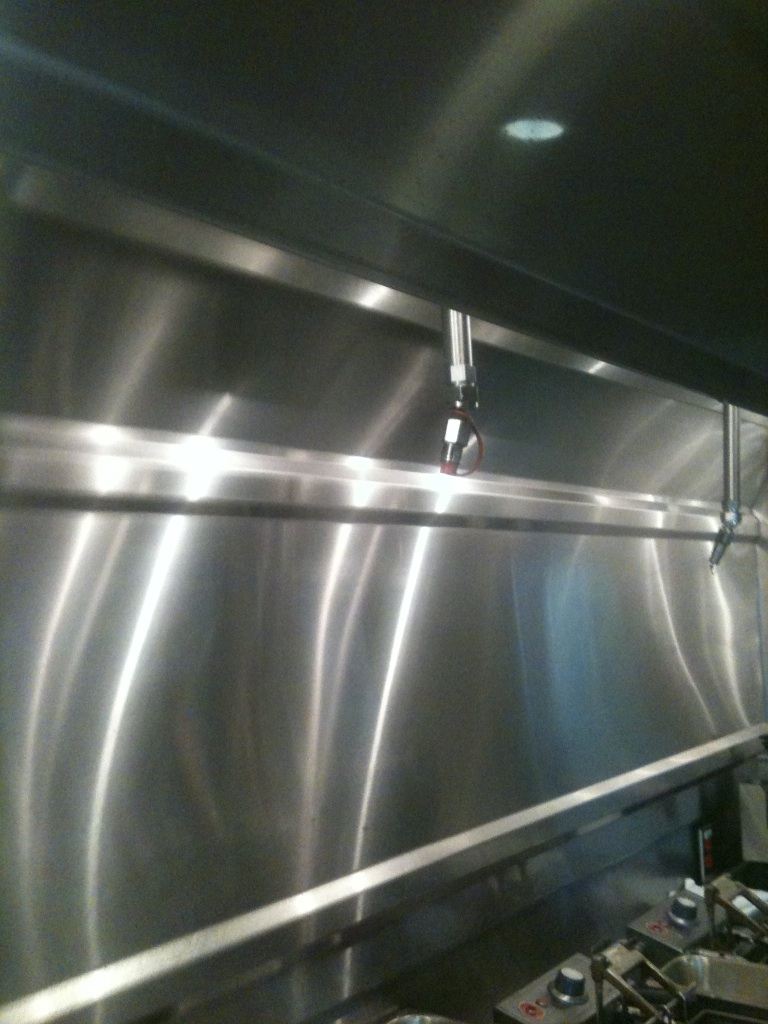
The wet function test is the practical point. The inspector watches the system actually discharge, so the provider has to plan the cleanup and recharge before you can cook. Both cities charge a permit fee; check their current packets. The kitchen fire suppression installation page explains how design, permitting and acceptance fit together.
Other Metro East cities
- Collinsville: the commercial business license packet reportedly asks for a current annual kitchen hood suppression inspection report and current extinguisher tags. Hood drawings aren't part of the building permit, so a separate mechanical permit is needed. Verify with the city, since we couldn't open the current documents.
- O'Fallon, Illinois: the city's fire code amendments name the Building and Inspection Division of Community Development as the "Department of Fire Prevention," while fire service stays with the O'Fallon Fire Department. Nearby, the O'Fallon–Shiloh Valley–Caseyville FPD reviews applications in its district.
- Granite City, Fairview Heights, Swansea, Alton and others: we haven't confirmed their hood procedures. Call the fire department before you start work.
Routine Service and Write-Ups
Semiannual service applies here too: NFPA 96 and the IFC call for service at least every six months and after any discharge. Fusible links are replaced at least every six months under NFPA 17A/NFPA 96 and manufacturer guidance; some code texts set an annual minimum. The kitchen fire suppression inspection page covers a typical visit. If a fire inspector or a business license review flagged your system, see fire code deficiency repair. After a discharge, you'll need a hood system recharge before cooking. Food permits come from the St. Clair County and Madison County health departments and are separate from fire permits.
Where Metro East Kitchens Are
- Downtown Belleville and Main Street, such as Tavern on Main at 301 E. Main.
- Edwardsville, including downtown and the SIUE campus.
- O'Fallon, Collinsville and Fairview Heights, including the St. Clair Square retail and restaurant corridor.
- DraftKings at Casino Queen in East St. Louis (rebranded in 2020).
Recent Kitchen Fires in the Metro East
- Hardee's, Glen Carbon (June 16, 2025). Glen Carbon Fire Chief Jason Whitaker said, "It was contained inside the hood system." Glen Carbon, Edwardsville and Maryville responded, and the health department planned to inspect the restaurant and its hood system.
- Captain D's, Edwardsville (March 4, 2026). The cause was reported as undetermined, and smoke and fire damage kept the location from reopening right away.
A fire kept inside the hood is the outcome hood protection is designed for, and it depends on a system that has been serviced and recharged on schedule.
Requesting Service in the Metro East
Tell us your city, the system brand from the cylinder label, your last service date, and any deadline from a fire inspector or business license renewal. If you have an ANSUL system, the ANSUL system service page lists questions to ask about manufacturer training. Our restaurant fire suppression cost guide explains what drives quotes.
Neighboring Areas
Across the Mississippi, St. Louis City uses the 2018 IFC with one fire department, and St. Louis County is split among dozens of fire authorities. We found no Missouri statewide technician license comparable to Illinois. St. Charles County, Missouri runs on the 2021 IFC with fire district occupancy permits.
Sources: Illinois OSFM, Life Safety Code; 41 Ill. Adm. Code 100.7; 41 Ill. Adm. Code 251.25; OSFM Plan Review Services; OSFM Hood & Duct Submittal Form; OSFM Fire Equipment Employee License Application; 41 Ill. Adm. Code 251; Belleville FD Permit Package 2025; Edwardsville Fire Permit Packet; Collinsville business license documents; O'Fallon IL fire code amendments; Shiloh IL code; Downstate IL, Tavern on Main; CDC Gaming, Casino Queen rebrand; EdGlen Today, Hardee's fire; RiverBender, Captain D's fire. Requirements vary by jurisdiction; confirm with your local fire official.