
Short answer: Before a fire inspection, confirm your hood suppression system has a service tag dated within the last six months and a written report, that nozzle caps, links, the pull station and the gas or electric shutoff are in order, and that every cooking appliance sits under its nozzles. Then check that a Class K extinguisher with its placard is within 30 feet of the cooking line, the hood has been cleaned on schedule, and exits are clear.
Before You Start: Who Decides
This list covers items that commonly come up, drawn from the fire code, NFPA standards, manufacturer guidance and fire department checklists. It isn't the official checklist for your kitchen. That comes from your fire department or fire protection district, the authority having jurisdiction (AHJ), and editions differ across the region. The City of St. Louis enforces the 2018 International Fire Code. Several St. Louis County districts, such as Metro West FPD, and St. Charles County jurisdictions, such as Wentzville FPD, have moved to the 2021 IFC. Illinois applies NFPA 101 (2015) statewide on top of each city's code. When in doubt, call your fire marshal's office and ask what they check.
1. Service Tag and Paperwork
- The suppression system tag is in place and dated within the last six months. The IFC and NFPA 96 both require service at least every six months and after any activation.
- You have the written report from the last service, and any deficiencies on it have been corrected.
- The tag records the fusible links' year of manufacture and installation date, as NFPA 96 requires.
- You know whether the inspection certificate was forwarded to your fire department. The IFC requires it to be sent to the fire code official.
- The hood cleaning company's label, with its name and the cleaning date, is on the hood, and you have its certificate or report.
- The agent cylinder's hydrostatic test date is current. Wet chemical cylinders are tested every 12 years under NFPA 17A.
If your tag is out of date, the kitchen fire suppression inspection page explains what a semiannual service covers.
2. Nozzles, Piping and Fusible Links
- Every nozzle has its blow-off cap in place, intact and not coated in grease. ANSUL tells owners to check caps daily.
- Nozzles are pointed at the appliance below them, and no piping is loose.
- Fusible links aren't caked in grease or corroded. Metal-alloy links are replaced at least every six months under NFPA 17A, NFPA 96 and manufacturer guidance; some code texts set an annual minimum.
- No link or cable was wired shut after hood cleaning. ANSUL notes cleaners sometimes do this to prevent an accidental discharge, which also stops the system from operating automatically.
- Tamper indicators and seals on the releasing unit are intact, and any gauge reads in its operable range.
3. Manual Pull Station
- It's located at or near a means of egress from the cooking area, at least 10 feet and no more than 20 feet from the kitchen exhaust system, under the IFC.
- It's mounted 42 to 48 inches above the floor and clearly identifies the hazard it protects.
- Nothing blocks it. The 2021 IFC (§904.13.1) adds that it must be "readily accessible and unobstructed." Watch for carts, racks and coat hooks.
4. Fuel and Electric Shutoff
- The system's actuation shuts off gas or electric power to the cooking equipment, and the reset is manual. The shutoff is tested at every semiannual service.
- Gas appliances under the same hood shut down too, even ones that don't need protection.
- Where your system ties into a building fire alarm or makeup-air controls, those interlocks are part of the test.
5. Appliances Under the Hood
- Every appliance that produces grease-laden vapors is protected by the system.
- Each appliance sits where the system was designed for it. Wheel stops or floor markings keep it there, and one Texas fire department lists their absence as the top reason installs fail.
- No appliance has been added, swapped or moved since the last service. Under the IFC and NFPA 96, those changes require the system to be brought into compliance.
- No smoker box or other solid-fuel holder has been added without the service provider evaluating the system first.
- If the system is an older dry chemical type, ask whether it's listed to UL 300. Our UL 300 compliance guide explains why that matters.
6. Class K Extinguisher and Placard
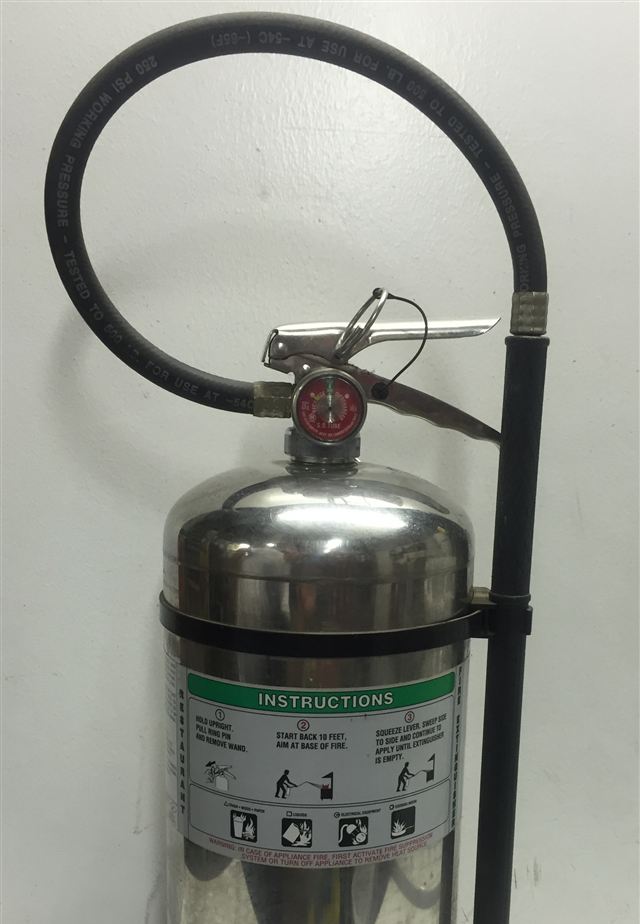
- A Class K extinguisher is within a 30-foot travel distance of the cooking equipment, per NFPA 10 and the IFC.
- A placard next to it says the hood system must be actuated before the extinguisher is used.
- ABC dry chemical extinguishers aren't relied on for the fryers. One insurer recommends removing them from the cooking area.
- Another suitable extinguisher covers the kitchen's other, non-cooking hazards.
- Nothing blocks access to any extinguisher.
Details on sizing and placement are in our Class K fire extinguisher requirements guide.
7. Hood, Filters and Duct Cleaning
Filters must be in place, and ANSUL says to use only UL-listed filters. Mesh filters and gaps between filters are common write-ups. The exhaust system must be inspected for grease buildup, and cleaned as needed, at least as often as NFPA 96 and the IFC require for your type of cooking:
| Type of cooking operation | Inspect (and clean as needed) at least |
|---|---|
| Solid fuel (wood, charcoal) | Monthly |
| High volume (cooking 24 hours a day, charbroiling, wok cooking) | Quarterly |
| Moderate volume (most restaurants) | Every six months |
| Low volume (churches, day camps, seasonal businesses, senior centers) | Annually |
Hood cleaning and suppression service are separate jobs. ANSUL recommends a suppression inspection right after a major hood and duct cleaning.
8. Your Monthly Owner Check
NFPA 17A calls for a monthly inspection that trained staff can do. Make it a habit, not just pre-inspection prep:
- The system is in its armed or ready position.
- Manual actuators are unobstructed.
- Tamper indicators and seals are intact, and the maintenance tag is in place.
- There's no obvious physical damage, and gauges read in range.
- Nozzle blow-off caps are in place and undamaged.
- Hoods, ducts and filters are in place and clean.
9. General Items Inspectors Commonly Check
A fire inspection covers more than the hood. These items appear on typical fire department restaurant checklists, such as the one Sioux Falls, South Dakota publishes. Your AHJ's list may differ:
- Exit doors, aisles, corridors and stairs are free of obstructions and storage.
- Exit doors have no chains, deadbolts or other prohibited locks.
- Exit signs are lit and visible, and emergency lights work on battery backup.
- Fire doors close and latch on their own.
- Portable extinguishers are visually inspected monthly and get an annual maintenance check, as OSHA requires of employers (29 CFR 1910.157). Keep the record.
If your system has recently discharged, read what to do after an Ansul system goes off. For quote questions, see what drives restaurant fire suppression cost.
Sources: 2015 IFC §904.12 (City of Lawrence, KS); Thornton (CO) FD requirements citing 2021 IFC §904.13; NFPA 96 maintenance text as extracted in the 2025 California Mechanical Code §514.2; Minnesota Dept. of Health kitchen equipment guide; ANSUL R-102 Owner's Guide; Prosper (TX) FD, Top Reasons Hood Suppression Systems Fail; Amerex, What Is a Class K Fire?; Grinnell Mutual, Class K Fire Extinguishers; Kansas State Fire Marshal Fire Fact 066; City of St. Louis adopted building codes; Illinois OSFM, Life Safety Code; Sioux Falls Fire Rescue restaurant checklist; OSHA 29 CFR 1910.157. Requirements vary by jurisdiction; confirm with your local fire official.