
Short answer: NFPA 10 requires a Class K extinguisher wherever there is a potential for fires involving cooking oils and fats, located within 30 feet of travel from the cooking hazard. Where a hood suppression system protects the line, a placard near the extinguisher must tell staff to activate the system first. Extinguishers get a monthly visual check and annual maintenance.
What a Class K Extinguisher Is For
Class K is the fire classification for combustible cooking media: vegetable oils, animal fats and shortening in fryers and on griddles. These fires are hard to put out because the oil is far above its ignition point and can reignite after the flames are knocked down. A Class K extinguisher discharges a wet chemical agent, similar in principle to the agent in most hood systems, designed specifically for hot cooking oil.
The ordinary extinguisher on the wall is not a substitute. ANSUL's owner's guide warns against using ABC dry chemical, carbon dioxide or water extinguishers on burning cooking oil. An insurer's loss-control bulletin goes further, saying dry chemical extinguishers "are not sufficient to put out kitchen fires involving vegetable-based cooking oils" and should be removed from the cooking area.
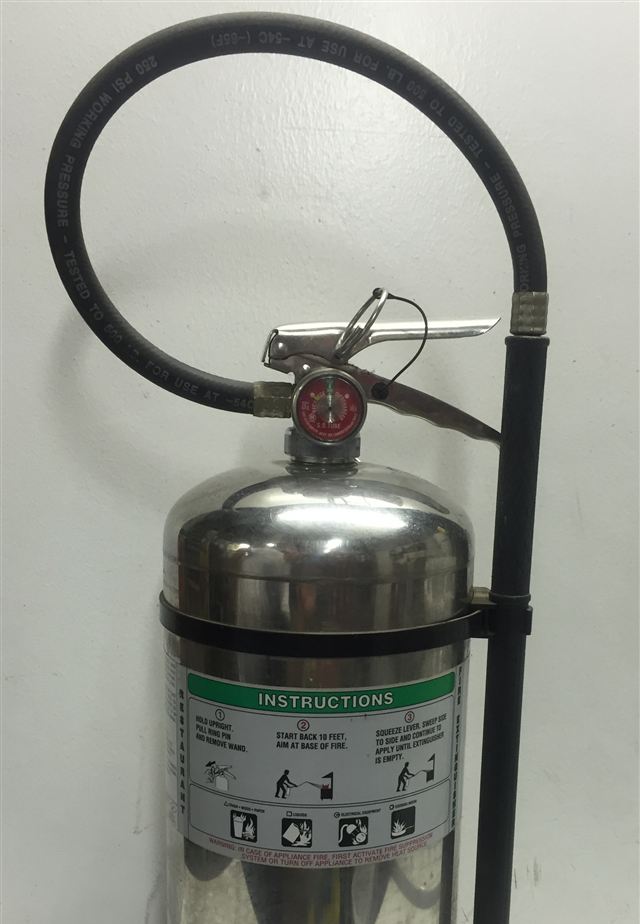
When Class K Is Required
NFPA 10, the portable extinguisher standard, requires Class K extinguishers "where there is a potential for fires involving combustible cooking media" (NFPA 10 §6.6.1, as quoted by Amerex). In practice, that means any commercial kitchen with fryers, griddles, ranges, woks or charbroilers using oil or fat. The International Fire Code says the same thing for commercial cooking equipment: in the 2015 edition it is §904.12.5, and in the 2021 edition the Class K requirements sit in Section 906.
Having a hood suppression system doesn't remove the requirement. NFPA 96 calls the automatic system the primary protection and the portable extinguisher the secondary backup. You need both. Food trucks are no exception: the IFC's mobile food vehicle section requires a portable extinguisher in addition to the automatic system. Our food truck fire suppression page covers the rest of what a truck needs.
Placement: The 30-Foot Rule
The maximum travel distance from the cooking hazard to a Class K extinguisher is 30 feet (9.1 m) under NFPA 10 §6.6.2. The 2015 IFC uses the same wording: "within a 30-foot (9144 mm) distance of travel from commercial-type cooking equipment."
"Travel distance" means the path a cook would actually walk, around prep tables and through doorways, not a straight line on the floor plan. A few practical points:
- Mount it where a cook can reach it while moving away from the fire, not on the far side of the fryer.
- Keep it clear. Inspectors write up extinguishers blocked by carts, boxes or bus tubs.
- If you have more than one cooking line, or a large line, check the travel distance from each end.
- After any remodel or line change, re-check the distance before your next inspection.
How Many and What Size
The 2015 IFC sets a simple rule for fryers: one 1.5-gallon Class K extinguisher covers up to four fryers with a cooking-medium capacity of up to 80 pounds each. Add one more extinguisher for each additional group of four fryers. Fryers with a surface area over 6 square feet follow the extinguisher manufacturer's recommendations. Solid fuel appliances with a firebox of 5 cubic feet or less need one 2.5-gallon or two 1.5-gallon Class K units.
Those figures come from the 2015 text. The City of St. Louis enforces the 2018 IFC and many county and St. Charles County jurisdictions enforce the 2021 IFC, so confirm the sizing rule in the edition your fire department or district uses. Our St. Louis County page explains why that varies from district to district.
The Required Placard
Where the cooking hazard is protected by an automatic system, NFPA 10 requires "a placard ... placed near the extinguisher" stating that the fire protection system "shall be actuated prior to using the fire extinguisher" (§5.5.4.5.3 as quoted by Amerex). A fire department document based on the 2021 IFC puts it as activation instructions that "shall be posted adjacent to each Class K rated portable fire extinguisher."
A missing placard is one of the items inspectors commonly flag, along with a missing Class K extinguisher. It is also one of the easiest to fix before the inspector arrives.
Use It After the Hood System Discharges
The placard reflects the right order of operations for a fire on the line:
- Pull the manual pull station. It sits near an exit path, 10 to 20 feet from the hood. Activating the system discharges agent over the appliances and, by code, automatically shuts off gas or electric power to the cooking equipment.
- Use the Class K extinguisher only if fire remains after the system has discharged, and only if it is safe to do so.
- Get out and call 911 if the fire isn't quickly controlled.
Using the portable extinguisher first means fighting a fire that still has fuel and heat feeding it. Pulling the station first cuts the fuel and floods the hazard. After any discharge, the system has to be serviced and recharged before you cook again; see what to do after an Ansul system goes off and our fire suppression recharge and repair page.
Training note: OSHA requires employers who provide portable extinguishers for employee use to give an education program on extinguisher use when employees start and at least annually after that (29 CFR 1910.157(g)). NFPA 96 also calls for food truck workers to be trained in using extinguishers and extinguishing systems.
Monthly Checks and Annual Maintenance
OSHA's workplace extinguisher rule requires portable extinguishers to be visually inspected monthly and to receive an annual maintenance check, with the annual maintenance date recorded (29 CFR 1910.157(e)). Fire codes reference NFPA 10 for extinguisher inspection and maintenance. One big-city fire policy, for example, says K-Class extinguishers "shall be serviced annually and as specified in the fire code and NFPA Standard 10."
A monthly check by a manager takes a minute per unit:
- In its assigned place, visible and unobstructed.
- Pin and tamper seal intact.
- Gauge (if any) in the operable range; the unit isn't visibly damaged, leaking or greasy.
- Placard posted next to it.
- Service tag present and showing current annual maintenance.
Annual maintenance is a hands-on examination by a qualified extinguisher service technician, who updates the tag. It's convenient to line it up with a semiannual kitchen fire suppression inspection, but they are separate items, and an inspector can cite an expired extinguisher tag even when the hood system tag is current.
Sources: Amerex, What Is a Class K Fire; 2015 IFC §904.12; Thornton (CO) FD, commercial cooking requirements (2021 IFC); Grinnell Mutual, Class K bulletin; ANSUL R-102 Owner's Guide; Prosper (TX) FD, top reasons hood systems fail; Minnesota Dept. of Health, kitchen equipment guide; NY DOS, mobile food preparation vehicles; NFPA food truck fact sheet; OSHA 29 CFR 1910.157; Portland Fire & Rescue policy FIR-8.03; City of St. Louis, adopted codes. Requirements vary by jurisdiction; confirm with your local fire official.